Add Two Numbers
LeetCode 2 | Difficulty: Medium
MediumProblem Description
You are given two non-empty linked lists representing two non-negative integers. The digits are stored in reverse order, and each of their nodes contains a single digit. Add the two numbers and return the sum as a linked list.
You may assume the two numbers do not contain any leading zero, except the number 0 itself.
Example 1:
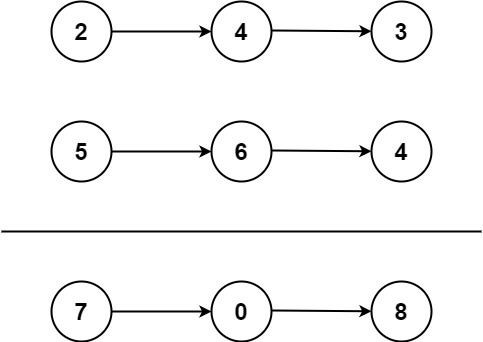
Input: l1 = [2,4,3], l2 = [5,6,4]
Output: [7,0,8]
Explanation: 342 + 465 = 807.
Example 2:
Input: l1 = [0], l2 = [0]
Output: [0]
Example 3:
Input: l1 = [9,9,9,9,9,9,9], l2 = [9,9,9,9]
Output: [8,9,9,9,0,0,0,1]
Constraints:
-
The number of nodes in each linked list is in the range
[1, 100]. -
0 <= Node.val <= 9 -
It is guaranteed that the list represents a number that does not have leading zeros.
Topics: Linked List, Math, Recursion
Approach
Mathematical
Look for mathematical patterns or formulas. Consider: modular arithmetic, GCD/LCM, prime factorization, combinatorics, or geometric properties.
Problems with clear mathematical structure, counting, number properties.
Linked List
Use pointer manipulation. Common techniques: dummy head node to simplify edge cases, fast/slow pointers for cycle detection and middle finding, prev/curr/next pattern for reversal.
In-place list manipulation, cycle detection, merging lists, finding the k-th node.
Solutions
Solution 1: Single Pass with Carry
Walk both lists simultaneously summing digit-by-digit with a carry. A dummy head simplifies the edge case for the very first digit.
/**
 * public class ListNode {
 *     public int val;
 *     public ListNode next;
 *     public ListNode(int val=0, ListNode next=null) {
 *         this.val = val;
 *         this.next = next;
 *     }
 * }
 */
public class Solution {
    public ListNode AddTwoNumbers(ListNode l1, ListNode l2) {
        var dummy = new ListNode();
        var curr = dummy;
        int carry = 0;
        while (l1 != null || l2 != null || carry != 0) {
            int sum = carry;
            if (l1 != null) { sum += l1.val; l1 = l1.next; }
            if (l2 != null) { sum += l2.val; l2 = l2.next; }
            carry = sum / 10;
            curr.next = new ListNode(sum % 10);
            curr = curr.next;
        }
        return dummy.next;
    }
}
Complexity Analysis
| Approach | Time | Space |
|---|---|---|
| Single pass with carry | for output |
Interview Tips
- Discuss the brute force approach first, then optimize. Explain your thought process.
- Draw the pointer changes before coding. A dummy head node simplifies edge cases.